A fit and tan Ringo Starr regaled a select group of fans yesterday in at a SiriusXM “Town Hall” held the Troubadour in Los Angeles, to promote the release of his new studio album Ringo 2012, out today. If you didn’t know the former Beatle was 71 years old, you would not have believed it — rarely has a septuagenarian rock star looked this good. He had fun with host Russell Brand, who has held back on a sex joke. “The whole day is sort of designed to elicit relentless ejaculation,” Brand told the crowd at the Troubadour before the event began. (“If I talk about relentless ejaculation now,” Brand added, apparently talking to a SiriusXM producer, “it probably won’t be part of the broadcast.”)
Sex jokes aside, a great deal of the hour-long audience Q&A — the second half of which was moderated by music producer Don Was — was spent on Beatles nostalgia, from reminiscing about their final rooftop concert (yesterday was that event’s 43rd anniversary, a fact that took Starr by surprise), all the way back to when the drummer would watch the Beatles perform before he’d joined the band. Starr told stories about how tough it was for him to get his own songs on a Beatles record, and how he phoned up Paul McCartney after 2003′s Let It Be…Naked was released to tell McCartney the album really did sound better without Phil Spector’s orchestral wall of sound. With real pride, Starr remarked more than once that no matter how they felt about each other personally, his bandmates “were all supporting each other [on stage] — in ’62 were like that and in 1970 we were still like that, musically.”
The thing about the Beatles, though, is that there is scarcely a molecule of the band’s ten-year history (or eight-year history, in Starr’s case) that hasn’t already been covered, scrutinized, and dissected many times over. The median age of the assembled crowd of SiriusXM contest winners was pushing 50, and although there were questions about Starr’s current album — as well as his charity work, his feelings about the digital music revolution, and his many collaborations over the years — not even Starr was under the illusion that anyone was there for any other reason than he’s one quarter of the Fab Four. When Starr capped off the event by playing with his band, 2 of the songs were Beatles hits (“I Wanna Be Your Man,” “With A Little Help From My Friends”). The only song he played from Ringo 2012, “Wings,” actually dates back to his 1977 album Ringo the 4th.
Wednesday, February 1, 2012

the famous band from the 60s the beatles
In March 1957, John Lennon, then aged sixteen, formed a skiffle group with several friends from Quarry Bank school. They briefly called themselves the Blackjacks, before changing their name to The Quarrymen, after discovering that a respected local group was already using the name.[4] Fifteen-year-old Paul McCartney joined as a guitarist shortly after he and Lennon met that July.[5] When McCartney in turn invited George Harrison to watch the group the following February, the fourteen-year-old joined as lead guitarist.[6][7] By January 1959, Lennon's schoolfriends had left the group, and he had begun studies at the Liverpool College of Art.[8] The three guitarists, billing themselves at least once as "Johnny and the Moondogs",[8] were playing rock and roll whenever they could find a drummer.[9]
Lennon's art school friend Stu Sutcliffe, who had recently sold one of his paintings and purchased a bass guitar using the proceeds, joined in January 1960.[10] It was he who suggested changing the band's name to "The Beetles" as a tribute to Buddy Holly and The Crickets.[11][12] According to Beatles experts Mark Lewishon and Bill Harry, they used the name "Beatals", through May,[8] when they became "The Silver Beetles",[13] before undertaking a brief tour of Scotland as the backing group for pop singer and fellow Liverpudlian Johnny Gentle.[14] By July they had changed their name to "The Silver Beatles",[15] and in August, to "The Beatles".[16]
The lack of a full-time drummer posed a problem when the group's unofficial manager, Allan Williams, arranged a resident band booking for them in Hamburg, Germany.[17] Before the end of August they auditioned and hired Pete Best,[18] and the five-piece band left for Hamburg four days later, contracted to club owner Bruno Koschmider, for a 48-night residency. "Hamburg in those days did not have rock 'n' roll music clubs. It had strip clubs", says Beatles biographer Philip Norman.[19]
During the next two years, the group were resident for further periods in Hamburg. They used Preludin both recreationally and to maintain their energy through all-night performances.[27] When Sutcliffe decided to leave the band in early 1961 and resume his art studies in Germany, McCartney took up the bass.[28][29] German producer Bert Kaempfert contracted what was now a four-piece group through June 1962, and he used them as Tony Sheridan's backing band on a series of recordings.[30] Credited to "Tony Sheridan & The Beat Brothers", the single "My Bonnie", recorded in June and released four months later, reached number 32 on the Musikmarkt chart.[31][32] The Beatles were also becoming more popular back home in Liverpool. In November, during one of the band's frequent appearances at the Cavern Club, they encountered Brian Epstein, a local record store owner and music columnist.[33] The band appointed Epstein manager in January 1962,[34] and he made efforts throughout the winter and spring to get them released from their contract with Bert Kaempfert Productions.[30] To secure an early release from the contract, Epstein negotiated for the band to provide one last recording session, at the end of May, during their next visit to Hamburg.[30] News of a tragedy greeted them on their return there in April.[35] Meeting them at the airport, a visibly upset Kirchherr told them of Sutcliffe's death, just hours earlier, from a brain haemorrhage.[36] Kaempfert released them from the record contract the day after the session, a month before it was to expire at the end of June.[30] After Decca Records rejected the band with the comment "Guitar groups are on the way out, Mr. Epstein",[37] George Martin signed the group to EMI's Parlophone label.[38]
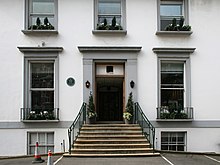
 Abbey Road Studios main entranceIn Liverpool, the Merseybeat movement was gaining popularity. The band had their first recording session under Martin's direction at EMI's Abbey Road Studios in London in June 1962. Martin complained to Epstein about Best's drumming and suggested the band use a session drummer in the studio.[39] Instead, Best was replaced by Ringo Starr. Starr, who left Rory Storm and the Hurricanes to join The Beatles, had already performed with them during Best's occasional absences.[40] Martin still hired session drummer Andy White for one session.[41] White played on the single "Love Me Do" and "P.S. I Love You". Released in October, "Love Me Do" was a top twenty UK hit, peaking at number seventeen on the chart.[42] After a November studio session that yielded what would be their second single, "Please Please Me", they made their TV debut with a live performance on the regional news programme People and Places.[43]
The band concluded their last Hamburg stint in December 1962.[19] By now it had become the pattern that all four members contributed vocals, although Starr's restricted range meant he rarely sang lead.[44] Lennon and McCartney had established a songwriting partnership; as the band's success grew, their celebrated collaboration limited Harrison's opportunities as a lead vocalist.[45] Epstein, sensing their commercial potential, encouraged the group to adopt a professional attitude to performing. Lennon recalled the manager saying, "Look, if you really want to get in these bigger places, you're going to have to change—stop eating on stage, stop swearing, stop smoking."[46] Lennon said, "We used to dress how we liked, on and off stage. He'd tell us that jeans were not particularly smart and could we possibly manage to wear proper trousers, but he didn't want us suddenly looking square. He'd let us have our own sense of individuality ... it was a choice of making it or still eating chicken on stage."[46]
 "The Beatles" logo painted on Starr's drumReleased in March 1963, the album reached number one on the British chart. This initiated a run during which eleven of their twelve studio albums released in the United Kingdom through 1970 hit number one. The band's third single, "From Me to You", came out in April and was also a chart-topping hit. It began an almost unbroken run of seventeen British number one singles for the band, including all but one of the eighteen they put out over the next six years. On its release in August, the band's fourth single, "She Loves You", achieved the fastest sales of any record in the UK up to that time, selling three-quarters of a million copies in under four weeks.[50] It became their first single to sell a million copies, and remained the biggest-selling record in the UK until 1978 when it was topped by "Mull of Kintyre", performed by McCartney and his post-Beatles band, Wings.[51] The popularity of their music brought with it increasing press attention. The band members responded with a cheeky, irreverent attitude that defied what was expected of pop musicians and inspired even more interest.[52][53]
Please Please Me was still topping the album chart. It maintained the position for thirty weeks, only to be displaced by With The Beatles which itself held the top spot for twenty-one weeks. Making much greater use of studio production techniques than its "deliberately primitive" predecessor, the album was recorded between July and October.[64] Erlewine describes With The Beatles as "a sequel of the highest order—one that betters the original by developing its own tone and adding depth."[65] In a reversal of what had until then been standard practice, the album was released in late November ahead of the impending single "I Want to Hold Your Hand", with the song excluded in order to maximize the single's sales.[66] With The Beatles caught the attention of The Times' music critic William Mann, who went as far as to suggest that Lennon and McCartney were "the outstanding English composers of 1963".[64] The newspaper published a series of articles in which Mann offered detailed analyses of the music, lending it respectability.[67] With The Beatles became the second album in UK chart history to sell a million copies, a figure previously reached only by the 1958 South Pacific soundtrack.[68] Drafting a press release shortly before the record came out, Tony Barrow, the band's press officer, coined a new descriptive phrase for the quartet that would be widely adopted: the "Fab Four".[69]
The Beatles' releases in the United States were initially delayed for nearly a year when Capitol Records, EMI's American subsidiary, declined to issue either "Please Please Me" or "From Me to You".[70] Negotiations with independent US labels led to the release of some singles, but issues with royalties and derision of the band's "moptop" hairstyle posed further obstacles.[71][72] Once Capitol did start to issue the material, rather than releasing the LPs in their original configuration, they compiled distinct US albums from an assortment of the band's recordings and issued songs of their own choice as singles.[73] American chart success came after Epstein arranged for a $40,000 US marketing campaign and secured the support of disk jockey Carrol James, who first played the band's records in mid-December 1963, initiating their music's spread across US radio. This triggered great demand, leading Capitol to rush-release "I Want to Hold Your Hand" that same month.[74] The band's US debut had already been scheduled to take place a few weeks later.
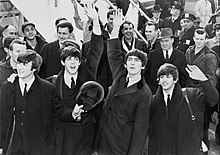 The Beatles arrive at John F. Kennedy International Airport, 7 February 1964The Beatles left the United Kingdom on 7 February 1964, with an estimated four thousand fans gathered at Heathrow, waving and screaming as the aircraft took off.[75] "I Want to Hold Your Hand" had sold 2.6 million copies in the US over the previous two weeks, but the group were still nervous about how they would be received.[76] At New York's John F. Kennedy Airport they were greeted by another vociferous crowd, estimated at about three thousand people.[77] They gave their first live US television performance two days later on The Ed Sullivan Show, watched by approximately 74 million viewers—over 40 percent of the American population.[78][79] The next morning one newspaper wrote that they "could not carry a tune across the Atlantic",[80] but a day later their first US concert saw Beatlemania erupt at Washington Coliseum.[81] Back in New York the following day, they met with another strong reception at Carnegie Hall. The band appeared on the weekly Ed Sullivan Show a second time, before returning to the UK on 22 February.[82] The Beatles held twelve positions on the Billboard Hot 100 singles chart during the week of 4 April, including the top five.[83] That same week, a third American LP joined the two already in circulation; all three reached the first or second spot on the US album chart. The band's popularity generated unprecedented interest in British music, and a number of other UK acts subsequently made their own American debuts, successfully touring over the next three years in what was termed the British Invasion.[84] The Beatles' hairstyle, unusually long for the era and mocked by many adults, was widely adopted and became an emblem of the burgeoning youth culture.[85]
 McCartney, Harrison and Lennon perform on Dutch television in 1964The Beatles toured internationally in June. Staging thirty-two concerts over nineteen days in Denmark, the Netherlands, Hong Kong, Australia and New Zealand, they were ardently received at every venue.[86][87] Starr was in hospital after a tonsillectomy for the first half of the tour, and Jimmie Nicol sat in on drums. In August they returned to the US, with a thirty-concert tour of twenty-three cities.[88] Generating intense interest once again, the month-long tour attracted between ten and twenty thousand fans to each thirty-minute performance in cities from San Francisco to New York. While in the United States the band stipulated that they would not play in front of segregated audiences.[89][90] Their music could hardly be heard,[88] as on-stage amplification at the time was modest compared to modern-day equipment, and the band's small Vox amplifiers struggled to compete with the volume of sound generated by screaming fans. Forced to accept that neither they nor their audiences could hear the details of their performance, the band grew increasingly bored with the routine of concert touring.[91]
At the end of the August tour they were introduced to Bob Dylan in New York at the instigation of journalist Al Aronowitz. Visiting the band in their hotel suite, Dylan introduced them to cannabis.[92] Beatles biographer Jonathan Gould points out the musical and cultural significance of this meeting, before which the musicians' respective fanbases were "perceived as inhabiting two separate subcultural worlds": Dylan's core audience of "college kids with artistic or intellectual leanings, a dawning political and social idealism, and a mildly bohemian style" contrasted with The Beatles' core audience of "veritable 'teenyboppers'—kids in high school or grade school whose lives were totally wrapped up in the commercialized popular culture of television, radio, pop records, fan magazines, and teen fashion. They were seen as idolaters, not idealists." Within six months of the meeting, "Lennon would be making records on which he openly imitated Dylan's nasal drone, brittle strum, and introspective vocal persona." Within a year, Dylan would "proceed, with the help of a five-piece group and a Fender Stratocaster electric guitar, to shake the monkey of folk authenticity permanently off his back...the distinctions between the folk and rock audiences would have nearly evaporated [and] The Beatles' audience...would be showing signs of growing up."[93]
Beatles for Sale, the band's fourth studio album, saw the emergence of a serious conflict between commercialism and creativity.[100] Recorded between August and October 1964, the album had been intended to continue the format established by A Hard Day's Night which, unlike the band's first two LPs, had contained no cover versions.[100] Acknowledging the challenge posed by constant international touring to the band's songwriting efforts, Lennon admitted, "Material's becoming a hell of a problem". Six covers from their extensive repertoire were included on the album.[100] Released in early December, its eight self-penned numbers nevertheless stood out, demonstrating the growing maturity of the material produced by the Lennon–McCartney partnership.[100]
In early 1965, while they were his guests for dinner, Lennon and Harrison's dentist secretly added LSD to their coffee. Lennon described the experience: "It was just terrifying, but it was fantastic. I was pretty stunned for a month or two."[101] He and Harrison subsequently became regular users of the drug, joined by Starr on at least one occasion.[102] McCartney was initially reluctant to try it, but eventually did so in the fall of 1966.[102] He later became the first Beatle to discuss LSD publicly, declaring in a magazine interview that "it opened my eyes" and "made me a better, more honest, more tolerant member of society."[103]
Controversy erupted in June 1965 when Elizabeth II appointed the four Beatles Members of the Order of the British Empire (MBE) after Prime Minister Harold Wilson nominated them for the award.[104] In protest—the honour was at that time primarily bestowed upon military veterans and civic leaders—some conservative MBE recipients returned their own insignia.[105]
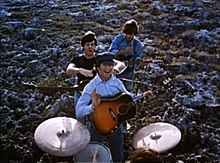 The US trailer for Help! with (from the rear) Harrison, McCartney, Lennon and (largely obscured) StarrThe Beatles' second film, Help!, again directed by Lester, was released in July. Described as "mainly a relentless spoof of Bond",[106] it inspired a mixed response among both reviewers and the band. McCartney said, "Help! was great but it wasn't our film—we were sort of guest stars. It was fun, but basically, as an idea for a film, it was a bit wrong."[107] The soundtrack was dominated by Lennon, who wrote and sang lead on most of its songs, including the two singles: "Help!" and "Ticket to Ride".[108] The accompanying album, the group's fifth studio LP, again contained a mix of original material and covers. Help! saw the band making increased use of vocal overdubs and incorporating classical instruments into their arrangements, notably the string quartet on the pop ballad "Yesterday".[109] Composed by McCartney, "Yesterday" would inspire the most recorded cover versions of any song ever written.[110] The LP's closing track, "Dizzy Miss Lizzy", became the last cover the band would include on an album. With the exception of Let It Be's brief rendition of the traditional Liverpool folk song "Maggie Mae", all of their subsequent albums would contain only self-penned material.[111]
The band's third US visit, on 15 August, opened with the first major stadium concert in history when they performed before a crowd of 55,600 at New York's Shea Stadium.[112] A further nine successful concerts followed in other American cities. Towards the end of the tour the group were introduced to Elvis Presley, a foundational musical influence on the band, who invited them to his home.[113] Presley and the band discussed the music business and exchanged anecdotes.[114][115] September saw the launch of an American Saturday morning cartoon series, The Beatles, that echoed A Hard Day's Night's slapstick antics. Original episodes appeared for the next two years, and reruns aired through 1969.[116]
Lennon's art school friend Stu Sutcliffe, who had recently sold one of his paintings and purchased a bass guitar using the proceeds, joined in January 1960.[10] It was he who suggested changing the band's name to "The Beetles" as a tribute to Buddy Holly and The Crickets.[11][12] According to Beatles experts Mark Lewishon and Bill Harry, they used the name "Beatals", through May,[8] when they became "The Silver Beetles",[13] before undertaking a brief tour of Scotland as the backing group for pop singer and fellow Liverpudlian Johnny Gentle.[14] By July they had changed their name to "The Silver Beatles",[15] and in August, to "The Beatles".[16]
The lack of a full-time drummer posed a problem when the group's unofficial manager, Allan Williams, arranged a resident band booking for them in Hamburg, Germany.[17] Before the end of August they auditioned and hired Pete Best,[18] and the five-piece band left for Hamburg four days later, contracted to club owner Bruno Koschmider, for a 48-night residency. "Hamburg in those days did not have rock 'n' roll music clubs. It had strip clubs", says Beatles biographer Philip Norman.[19]
Harrison, only 17 years old in August 1960, obtained permission to stay in Hamburg by lying to the German authorities about his age.[20] Initially placing the group at the Indra Club, Koschmider moved them to the Kaiserkeller in October after the Indra was closed down due to noise complaints.[21] When he learned they were also performing at The Top Ten Club, a rival venue, Koschmider reported the underage Harrison to the authorities, leading to his deportation in November.[22][23] A week later, McCartney and Best were arrested for arson after they set fire to a condom nailed to a wall in their room; they were also deported.[24] Lennon returned to Liverpool in mid-December, while Sutcliffe remained in Hamburg with his new German fiancée, Astrid Kirchherr, for another month. Kirchherr took the first professional photos of the group and cut Sutcliffe's hair in the German "exi" (existentialist) style of the time, a look later adopted by the other Beatles.[25][26]Bruno had the idea of bringing in rock groups to play in various clubs. They had this formula. It was a huge nonstop show, hour after hour, with a lot of people lurching in and the other lot lurching out. And the bands would play all the time to catch the passing traffic. In an American red-light district, they would call it nonstop striptease. Many of the bands that played in Hamburg were from Liverpool. ... It was an accident. Bruno went to London to look for bands. But he happened to meet a Liverpool entrepreneur in Soho, who was down in London by pure chance. And he arranged to send some bands over.[19]
During the next two years, the group were resident for further periods in Hamburg. They used Preludin both recreationally and to maintain their energy through all-night performances.[27] When Sutcliffe decided to leave the band in early 1961 and resume his art studies in Germany, McCartney took up the bass.[28][29] German producer Bert Kaempfert contracted what was now a four-piece group through June 1962, and he used them as Tony Sheridan's backing band on a series of recordings.[30] Credited to "Tony Sheridan & The Beat Brothers", the single "My Bonnie", recorded in June and released four months later, reached number 32 on the Musikmarkt chart.[31][32] The Beatles were also becoming more popular back home in Liverpool. In November, during one of the band's frequent appearances at the Cavern Club, they encountered Brian Epstein, a local record store owner and music columnist.[33] The band appointed Epstein manager in January 1962,[34] and he made efforts throughout the winter and spring to get them released from their contract with Bert Kaempfert Productions.[30] To secure an early release from the contract, Epstein negotiated for the band to provide one last recording session, at the end of May, during their next visit to Hamburg.[30] News of a tragedy greeted them on their return there in April.[35] Meeting them at the airport, a visibly upset Kirchherr told them of Sutcliffe's death, just hours earlier, from a brain haemorrhage.[36] Kaempfert released them from the record contract the day after the session, a month before it was to expire at the end of June.[30] After Decca Records rejected the band with the comment "Guitar groups are on the way out, Mr. Epstein",[37] George Martin signed the group to EMI's Parlophone label.[38]

The band concluded their last Hamburg stint in December 1962.[19] By now it had become the pattern that all four members contributed vocals, although Starr's restricted range meant he rarely sang lead.[44] Lennon and McCartney had established a songwriting partnership; as the band's success grew, their celebrated collaboration limited Harrison's opportunities as a lead vocalist.[45] Epstein, sensing their commercial potential, encouraged the group to adopt a professional attitude to performing. Lennon recalled the manager saying, "Look, if you really want to get in these bigger places, you're going to have to change—stop eating on stage, stop swearing, stop smoking."[46] Lennon said, "We used to dress how we liked, on and off stage. He'd tell us that jeans were not particularly smart and could we possibly manage to wear proper trousers, but he didn't want us suddenly looking square. He'd let us have our own sense of individuality ... it was a choice of making it or still eating chicken on stage."[46]
Beatlemania and touring years (1963–1966)
UK popularity, Please Please Me and With The Beatles
In the wake of the moderate success of "Love Me Do", "Please Please Me" met with a more emphatic reception, reaching number two on the UK singles chart after its January 1963 release. Martin originally intended to record The Beatles' debut LP live at the Cavern Club. Finding it had "the acoustic ambience of an oil tank",[47] he elected to create a "live" album in one session at Abbey Road Studios. Ten songs were recorded for Please Please Me, accompanied on the album by the four tracks already released on the two singles.[47] Recalling how the band "rushed to deliver a debut album, bashing out Please Please Me in a day", Allmusic's Stephen Thomas Erlewine comments, "Decades after its release, the album still sounds fresh, precisely because of its intense origins."[48] Lennon said little thought went into composition at the time; he and McCartney were "just writing songs à la Everly Brothers, à la Buddy Holly, pop songs with no more thought of them than that—to create a sound. And the words were almost irrelevant."[49]
The Beatles' logo, seen on the front of Starr's bass drum during the group's major touring years,[55] was based on an impromptu sketch by instrument retailer and designer Ivor Arbiter upon instruction from Epstein that the design should emphasize the word "beat".[56][57] The band toured the UK three times in the first half of the year: a four-week tour that began in February preceded three-week tours in March and May–June. As their popularity spread, a frenzied adulation of the group took hold, dubbed "Beatlemania". Although not billed as tour leaders, they overshadowed other acts including Tommy Roe, Chris Montez and Roy Orbison, American artists who had established great popularity in the UK.[58] Performances everywhere, both on tour and at many one-off shows around the country, were greeted with riotous enthusiasm by screaming fans.[59] In late October, a five-day tour of Sweden saw the band venture abroad for the first time since the Hamburg chapter.[60] Returning to the UK, they were greeted at Heathrow Airport in heavy rain by thousands of fans in "a scene similar to a shark-feeding frenzy", attended by fifty journalists and photographers and a BBC Television camera crew.[61] The next day, they began yet another British tour, scheduled for six weeks. By now, they were indisputably the headliners.[58] Before a concert in Plymouth, police found it necessary to use high-pressure water hoses to control the crowds, and there were debates in Parliament concerning the thousands of police officers putting themselves at risk to protect the group.[62][63]

Please Please Me was still topping the album chart. It maintained the position for thirty weeks, only to be displaced by With The Beatles which itself held the top spot for twenty-one weeks. Making much greater use of studio production techniques than its "deliberately primitive" predecessor, the album was recorded between July and October.[64] Erlewine describes With The Beatles as "a sequel of the highest order—one that betters the original by developing its own tone and adding depth."[65] In a reversal of what had until then been standard practice, the album was released in late November ahead of the impending single "I Want to Hold Your Hand", with the song excluded in order to maximize the single's sales.[66] With The Beatles caught the attention of The Times' music critic William Mann, who went as far as to suggest that Lennon and McCartney were "the outstanding English composers of 1963".[64] The newspaper published a series of articles in which Mann offered detailed analyses of the music, lending it respectability.[67] With The Beatles became the second album in UK chart history to sell a million copies, a figure previously reached only by the 1958 South Pacific soundtrack.[68] Drafting a press release shortly before the record came out, Tony Barrow, the band's press officer, coined a new descriptive phrase for the quartet that would be widely adopted: the "Fab Four".[69]
"British Invasion"
 | Sample of the single "I Want to Hold Your Hand" (1963) which cemented the band's international success when it achieved enormous US popularity a few weeks before their debut in the country |
| Problems listening to this file? See media help. | |


At the end of the August tour they were introduced to Bob Dylan in New York at the instigation of journalist Al Aronowitz. Visiting the band in their hotel suite, Dylan introduced them to cannabis.[92] Beatles biographer Jonathan Gould points out the musical and cultural significance of this meeting, before which the musicians' respective fanbases were "perceived as inhabiting two separate subcultural worlds": Dylan's core audience of "college kids with artistic or intellectual leanings, a dawning political and social idealism, and a mildly bohemian style" contrasted with The Beatles' core audience of "veritable 'teenyboppers'—kids in high school or grade school whose lives were totally wrapped up in the commercialized popular culture of television, radio, pop records, fan magazines, and teen fashion. They were seen as idolaters, not idealists." Within six months of the meeting, "Lennon would be making records on which he openly imitated Dylan's nasal drone, brittle strum, and introspective vocal persona." Within a year, Dylan would "proceed, with the help of a five-piece group and a Fender Stratocaster electric guitar, to shake the monkey of folk authenticity permanently off his back...the distinctions between the folk and rock audiences would have nearly evaporated [and] The Beatles' audience...would be showing signs of growing up."[93]
A Hard Day's Night, Beatles for Sale, Help! and Rubber Soul
Capitol Records' lack of interest throughout 1963 had not gone unnoticed. A competitor, United Artists Records, encouraged United Artists' film division to offer The Beatles a motion picture contract in the hope that it would lead to a record deal.[94] Directed by Richard Lester, A Hard Day's Night had the group's involvement for six weeks in March–April 1964 as they played themselves in a boisterous mock-documentary.[95] The film premiered in London and New York in July and August, respectively, and was an international success.[96] The Observer's reviewer, Penelope Gilliatt, noted that "the way The Beatles go on is just there, and that's it. In an age that is clogged with self-explanation this makes them very welcome. It also makes them naturally comic."[97] According to Erlewine, the accompanying soundtrack album, A Hard Day's Night, saw them "truly coming into their own as a band. All of the disparate influences on their first two albums had coalesced into a bright, joyous, original sound, filled with ringing guitars and irresistible melodies."[98] That "ringing guitar" sound was primarily the product of Harrison's 12-string electric Rickenbacker, a prototype given him by the manufacturer, which made its debut on the record. Harrison's ringing 12-string inspired Roger McGuinn, who obtained his own Rickenbacker and used it to craft the trademark sound of The Byrds.[99]Beatles for Sale, the band's fourth studio album, saw the emergence of a serious conflict between commercialism and creativity.[100] Recorded between August and October 1964, the album had been intended to continue the format established by A Hard Day's Night which, unlike the band's first two LPs, had contained no cover versions.[100] Acknowledging the challenge posed by constant international touring to the band's songwriting efforts, Lennon admitted, "Material's becoming a hell of a problem". Six covers from their extensive repertoire were included on the album.[100] Released in early December, its eight self-penned numbers nevertheless stood out, demonstrating the growing maturity of the material produced by the Lennon–McCartney partnership.[100]
In early 1965, while they were his guests for dinner, Lennon and Harrison's dentist secretly added LSD to their coffee. Lennon described the experience: "It was just terrifying, but it was fantastic. I was pretty stunned for a month or two."[101] He and Harrison subsequently became regular users of the drug, joined by Starr on at least one occasion.[102] McCartney was initially reluctant to try it, but eventually did so in the fall of 1966.[102] He later became the first Beatle to discuss LSD publicly, declaring in a magazine interview that "it opened my eyes" and "made me a better, more honest, more tolerant member of society."[103]
Controversy erupted in June 1965 when Elizabeth II appointed the four Beatles Members of the Order of the British Empire (MBE) after Prime Minister Harold Wilson nominated them for the award.[104] In protest—the honour was at that time primarily bestowed upon military veterans and civic leaders—some conservative MBE recipients returned their own insignia.[105]

The band's third US visit, on 15 August, opened with the first major stadium concert in history when they performed before a crowd of 55,600 at New York's Shea Stadium.[112] A further nine successful concerts followed in other American cities. Towards the end of the tour the group were introduced to Elvis Presley, a foundational musical influence on the band, who invited them to his home.[113] Presley and the band discussed the music business and exchanged anecdotes.[114][115] September saw the launch of an American Saturday morning cartoon series, The Beatles, that echoed A Hard Day's Night's slapstick antics. Original episodes appeared for the next two years, and reruns aired through 1969.[116]
Subscribe to:
Posts (Atom)